Light Can Reveal the Freshness of Salmon Fillets
In recent years scientists have been aware that spectroscopic analyses may be used to determine fres…In recent years scientists have been aware that spectroscopic analyses may be used to determine freshness and shelf life. This is achieved by illuminating the salmon fillet and then studying how the light spectrum changes. The methods are non-destructive or, in other words, the fish may be used afterwards.
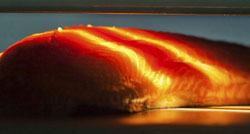
Chemical or microbiological methods have traditionally been used to determine the freshness of fish. However, these methods are resource-demanding and consequently impractical in the modern food industry.
Research Fellow Izumi Sone at the food research institute Nofima has in her PhD thesis at the University of Tromsø mapped the causes of the changes in the light spectrum.
The results point to the fact that the changes may be detected after only two days and may be attributed to degradation processes in the muscle.
Iron bearing proteins
“A primary source of the spectral changes is iron bearing proteins, known as haem proteins, in the muscle. In such proteins, the best known of which is haemoglobin, the iron exists in a natural form in a reduced state. A reduced form of iron is unstable and is therefore oxidized rapidly in the muscle when oxygen is present,” says Research Fellow Izumi Sone at Nofima.
Spectral property changes resulting from bacteria growth were only detected after a long period of cold storage.
The work also documented that spectroscopic analyses may also be used to determine whether a salmon fillet has been air-stored, stored as a vacuum-packed product or stored under modified atmosphere.
“These results will contribute to more easily being able to evaluate the freshness of fillet and in this way have better control of the degradation processes after slaughter and processing,” says supervisor and Senior Scientist Karsten Heia at Nofima.
Izumi Sone comes originally from Japan. She is educated at the University of Hawaii, University of Bergen and University of Tromsø. After completing her PhD, Sone will start as a scientist at Nofima in Stavanger, where she will work with seafood and quality, with focus on gentle processes and technologies that preserve the quality to the best extent possible.