Rapeseed Oil Gets Biotech Boost
Vegetable oils are obtained from the seeds and fruits of crop plants such as oilseed rape, sunflower…Vegetable oils are obtained from the seeds and fruits of crop plants such as oilseed rape, sunflower, soybean and palm. They are a major global commodity and contribute significantly to our bio-economy. World production has surpassed 150 million tons per year for the first time and is predicted to rise by 50 per cent within 20 years to meet growing demand.
Vegetable oils are used primarily as ingredients in food and for cooking. They are a source of essential fatty acids (i.e. omega-3 and -6) and can form a substantial proportion of the calories in the Western diet (up to 25 per cent). They are also used in the production of many non-food products such as paints, lubricants, cosmetics, detergents, plastics and resins, and increasingly they are feedstock for the production of biofuels. In doing so, they present more sustainable alternatives to petrochemicals, from which many of these products are currently derived.
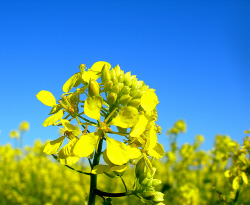
In the UK oilseed rape (Brassica napus) is our major vegetable oil crop. Over 700,000 hectares were grown this year, producing close to £900 million worth of seed.
In the experiment, performed on oilseed rape and published in The Plant Biotechnology Journal, the team use RNAi suppression as a tool to switch off the enzyme responsible for oil breakdown, specifically for the duration of seed development. This results in the accumulation of around eight per cent more oil in the seed.
The work, sponsored by the UK Biotechnology and Biological Sciences Research Council, was performed in collaboration with BASF Plant Science. The team believes that further work would be required to establish the efficacy of this method in the field and also to investigate whether it could be applied to other oilseed crops, or successfully combined with alternative approaches to boost yield.
Dr Pete Eastmond at Rothamsted Research said "Oilseed rape has become quite a profitable crop in recent years and the scale of cultivation in the UK has increased substantially. Farmers receive a bonus at market, based on the oil content of their seed. If this technology translates from laboratory to field, we estimate it could be worth an extra £40 million per year to farmers in the UK alone."
The work could have wider implications for global food security. The Food and Agriculture Organization of the United Nations (FAO) forecasts that global food production will need to increase by over 40 per cent by 2030, and 70 per cent by 2050. Even now in the second decade of the 21st century nearly one billion people are undernourished and food prices are at an all-time high, with price volatility leading to socioeconomic impacts, such as civil unrest. The UK Government’s Chief Scientific Adviser, Sir John Beddington, has concluded “The challenge for global agriculture is to grow more food on not much more land, using less water, fertiliser and pesticides than we have historically done."