Freeze-dried fruit tech to help reduce food waste, increase incomes for farmers
Freeze-dried food was once the staple of astronauts, but the technology could be the solution to sav…Freeze-dried food was once the staple of astronauts, but the technology could be the solution to saving billions of dollars worth of wasted Australian produce.
Australians bin about $10 billion worth of food every year and according to Foodwise $2.76 billion of that is fresh produce.
That includes farm 'seconds', which is produce considered too unattractive to be sold in supermarkets and often gets destroyed before it even leaves the farm.
Between 20 to 40 per cent of fruit and vegetables grown on farms usually gets rejected for cosmetic reasons, but a Queensland food processor is on a mission to change that.
Freeze Dry Industries on the Sunshine Coast opened earlier this year, and has fast become an outlet for local farmers looking to make money off crop that would otherwise go in the bin.
"Freeze-drying is a very scientific process, which has origins with NASA as space food," chief executive officer Michael Buckley said.
"My inspiration came from the pure joy of the technology in attacking waste, because I hate the thought of us throwing out beautiful fresh fruit and vegetables."
The freeze-drying production process is complicated.
The fresh fruit is placed in a large dryer, pressurised and then frozen.
The temperature in the chamber is then increased slightly, enabling the ice in the fruit to convert to a vapour and escape, in a process known as sublimation.
The vapour is sucked out of the dryer, and the dried fruit is left behind, minus any moisture.
"You go from a solid state back to a solid state but there is never a liquid state, so you have a perfectly dried piece of fruit without any water in it," Mr Buckley said.
"It goes from being a normal piece of fruit or vegetable to a crunchy one."
There are about four commercial freeze-drying operations in Australia, but Mr Buckley said his factory was the largest of its kind, with plans to double in capacity.
"We plan to be a world leader and showcase energy efficient freeze drying from here on the Sunshine Coast," he said.
Freeze-dry technology inspires farmers
Freeze Dry Industries began by buying and processing farm seconds such as strawberries, bananas, mangoes and apples, then selling the freeze-dried versions online.
However, the company, which has only been operating for three months, has since captured the imagination of local farmers, and is now fielding requests from growers keen to experiment and value add to their farm seconds.
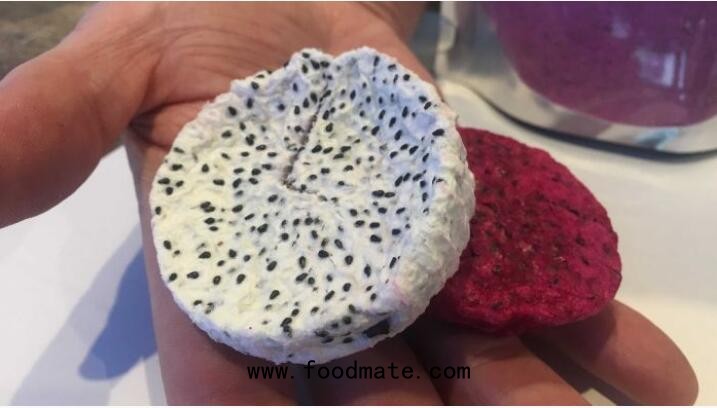
A local dairy farmer has trialled freeze-drying her camel milk, while a nearby dragon fruit farmer is using the factory to produce dragon fruit chips.
But rather than just wanting dried fruit, farmers are also freeze drying parts of the fruit that are otherwise inedible, such as the core of pineapples, or fruit skins.
"The dragon fruit skin has been milled as an experiment. It's a beautiful rich pink colour and the science around it is exciting, but otherwise it is a waste product," Mr Buckley said.
The dragon fruit skin has potential as a colouring agent, or as an ingredient in smoothies and health products.
"We have done pineapple cores too, for its high intensity in fibre and bromelains," Mr Buckley said.
Bromelain is effective at removing inflammation from injuries and infection, according to the University of Maryland Medical Centre.
While bromelain is found in the juice, it is more concentrated in the pineapple core, which is often too tough to eat and usually discarded.
Mr Buckley sees a market in freeze-drying the core and milling it to a powder form.
"I trialled some cores and powdered it and sent it to a naturopath, and they were terribly excited after testing it and are now ordering it in commercial quantities, which is a great result," he said.
Mr Buckley has done similar experiments with coconut flesh, avocado skins, seaweed and even cheese.
Farmers who have experimented with freeze drying often then seek out food technology specialists, dieticians or nutritionists to see if their product has any health benefit claims, which help make it more marketable.
To freeze or not to freeze?
Freeze-dried fruit can be expensive to produce and therefore more expensive to buy.
A packet of freeze-dried banana contains one small banana and costs $3.95, which is considerably more than the cost of a fresh banana at the supermarket.
That is because the technology is expensive, according to Dr Nenad Naumovski, a specialist in food science and nutrition at the University of Canberra.
"Freeze-drying machines can start from $50,000 plus, and from an industrial perspective, some can cost up to $300,000," he said.
However, Mr Buckley argues consumers are prepared to pay more for the experience of eating a freeze-dried snack.
For farmers, the option of earning money from a waste product, despite the cost, is an incentive for many growers.
However, there are some challenges farmers need to consider, according to Dr Naumovski.
"One of the problems is before fruit can be freeze-dried it needs to be completely frozen, so larger fruits need to be cut into smaller pieces to freeze quickly," he said.
Dr Naumovski said some farmers might not have the ability to freeze product as soon as it was picked, and may also have transport problems when trying to get it to a freeze-dry facility.
Despite the challenges, Mr Buckley expects the interest in freeze-dried fruits to increase, largely driven by demand from parents and the health food industry.