New, cost-cutting approach to formulating pest-killing fungi
Biopesticides containing beneficial fungi are often grown on grains or other solids, but US Departme…
 Biopesticides containing beneficial fungi are often grown on grains or other solids, but US Department of Agriculture (USDA) scientists have shown a liquid diet can work better.
The approach, dubbed "liquid culture fermentation," offers several benefits, including lower material costs and increased yields of certain forms of insect-killing fungi, including Isaria or Metarhizium, which can serve as biobased alternatives to synthetic pesticides.
For decades, biopesticide makers have grown such fungi on moistened grains or other solid materials to prompt them to churn out billions of specialised cells called "conidia," which penetrate the bodies of silverleaf whiteflies, aphids and other soft-bodied insect pests, killing the pests within a few days.
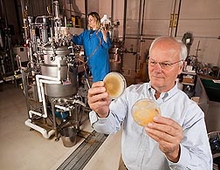
Over the past several years, however, scientists with USDA's Agricultural Research Service (ARS) have sought to improve on the practice by initiating liquid culture fermentation processes in special tanks called bioreactors. ARS is USDA's chief intramural scientific research agency.
According to Mark Jackson, a microbiologist with the ARS Crop Bioprotection Research Unit in Peoria, Ill., using liquid culture fermentation has significantly reduced production costs, especially those associated with nitrogen as a primary fungal nutrient.
One nitrogen source, called hydrolyzed protein, is typically derived from agricultural commodities like milk casein, which can sell for more than $6 a pound. Liquid culture fermentation's use of less expensive nitrogen sources, including soybean flour or cottonseed meal, reduces the cost to 30 to 50 cents a pound.
Conidia have long been the spores of choice for biopesticide uses. But the researchers showed that other fungal cells can be just as effective, including "blastospores" and "microsclerotia." The latter are clumps of pigmented fibers from which conidia can form. In laboratory tests, for example, conidia resulting from soil treatments of microsclerotia from the fungus M. brunneum killed 100 per cent of sugarbeet root maggots, versus 25 per cent killed for conidia-only treatments.
The flexibility of liquid culture fermentation to produce different types of fungal cells opens all sorts of doors in terms of where and when the pest-fighting microbes can be applied, according to Jackson.